A few days ago, EV Sales, an American new energy vehicle sales statistics website, released the sales data of new energy vehicles in various regions of the world in the first half of 2019. In the first half of the year, the total global sales of new energy vehicles reached 1,117,484 units, a year-on-year increase of 47.4%. In the first half of the year, the proportion of new energy vehicles reached 2.4%, an increase of 0.8 percentage points compared with the same period last year. In the context of the global auto market downturn, the growth momentum of new energy vehicles is very rapid.
After sorting out the data of websites such as EV Sales and domestic car association, 15 tables were compiled, which mainly observed the sales of new energy vehicle models and brands in the world, China, the United States and Europe, and compared the best-selling models and brands in the three regions horizontally, and interpreted the trend of the new energy vehicle market in the first half of 2019 in detail.
In the global sales ranking of new energy vehicles, it firmly occupied the first place in the list with the sales data of 160,000 vehicles, with a market share of 14%. Followed by three domestic car companies, BAIC and SAIC, the total sales of new energy vehicles of the three car companies in the first half of the year exceeded 270,000 units, which was close to a quarter of the total sales of new energy vehicles in the first half of the year. In addition, domestic car companies such as,, etc. also appeared in the top ten of the list, ranking seventh and tenth with sales of 47,000 units and 32,000 units respectively.
On the whole, the growth rate of models in the first half of this year is much larger than that of plug-in new energy vehicles. Especially in June this year, the year-on-year growth rate of sales exceeded 100%, while the year-on-year growth rate of plug-in models was 67%. In the first half of this year, the proportion of pure electric new car sales also increased from 69% last year to 76%.
It can be seen from this trend that the market share of plug-in and hybrid vehicles as transitional new energy vehicles is gradually decreasing, and the process of vehicle electrification is progressing steadily, and the era of pure electricity has become an obvious trend.
New energy vehicles continued to maintain strong growth in 2019. According to the data released by EV Sales, the global total sales of new energy vehicles reached more than 1.11 million units in the first half of this year, with a year-on-year growth rate of 47.4%.
In the first half of the global automobile sales, the sales of new energy vehicles accounted for 2.4%, an increase of 0.8 percentage points compared with the same period last year.
Judging from this trend, the growth momentum of new energy vehicles is very strong, especially in June, when the global sales of new energy vehicles approached 265,000, which is the second highest monthly sales of new energy vehicles, second only to the sales of 283,000 vehicles in December last year.
According to the law of the automobile market, the second half of each year is the real peak season for car purchase. With an average growth rate of 40%, the total sales volume of new energy vehicles this year is expected to exceed 3 million units.
The general trend is gratifying, and the new energy achievements of various car companies are also quite good. All car companies with strong new energy strategies have handed in satisfactory mid-year exam papers.
1. Top ten global manufacturers of new energy vehicles.
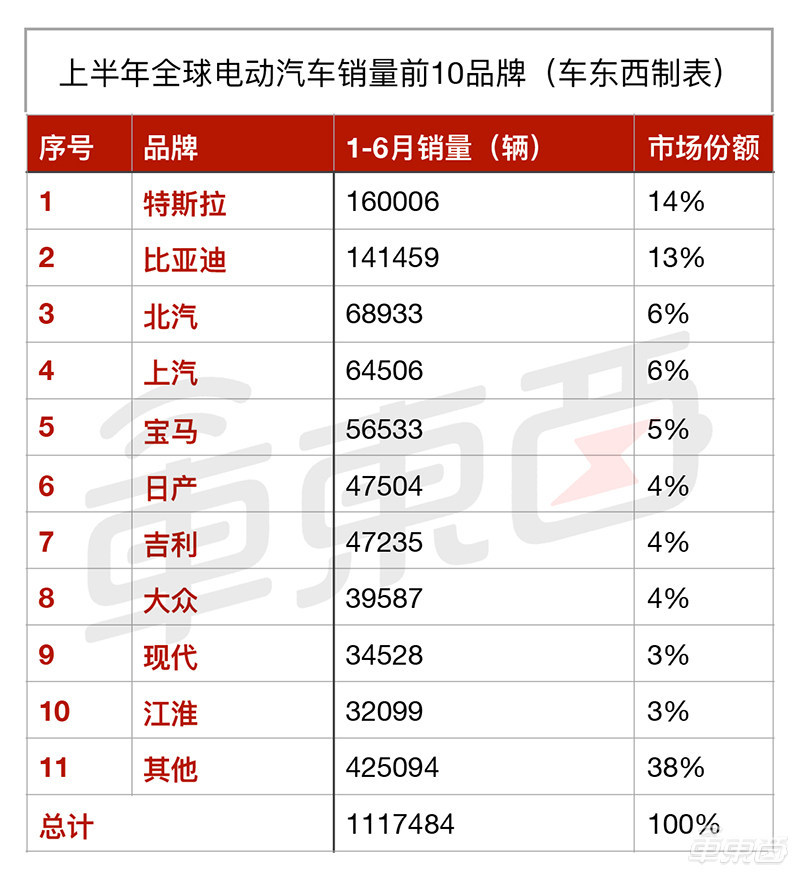
Top ten global manufacturers of new energy vehicles.
In the overall list of global electric vehicle sales, Tesla ranked first with sales of more than 160,000 vehicles. The best-selling model is the main source of its sales. From the perspective of a single model, the global sales volume of Model 3 in the first six months was close to 130,000, and in Europe and America, this model was firmly ranked first in the sales list. However, because Model 3 has not entered China for a long time, its sales performance in China has not yet shown its edge.
Following Tesla’s list are three China car companies, BYD, BAIC and SAIC. BYD’s huge new energy family has occupied a large number of markets for it; BAIC’s EU series successfully took over the banner of EC series domestic "sales king"; SAIC’s strategy of steady and steady new energy series has also achieved good results. In the first half of this year, the total sales volume of new energy vehicles of these three car companies exceeded 270,000, accounting for 25% of the global new energy vehicle market.
In addition to the above three China car companies, domestic independent brands Geely and Jianghuai also entered the top ten with sales of 47,000 vehicles and 32,000 vehicles respectively, and China car companies accounted for half of the top ten global new energy brands.
It is also worth mentioning that, as the only luxury car company, its performance in the field of new energy in the first half of this year is also remarkable. Hybrid models such as BMW 530e/Le and other pure electric models won the fifth place. In particular, i3, which has entered the end of the product cycle, sold nearly 20,000 vehicles worldwide in the first half of this year, an increase of over 20% year-on-year.
With the development of BMW’s new energy strategy, the mass production of iX3, iX5, I and other models will come out, and BMW’s market in the new energy field will be further expanded.
2. Top 10 models of global new energy vehicle sales.
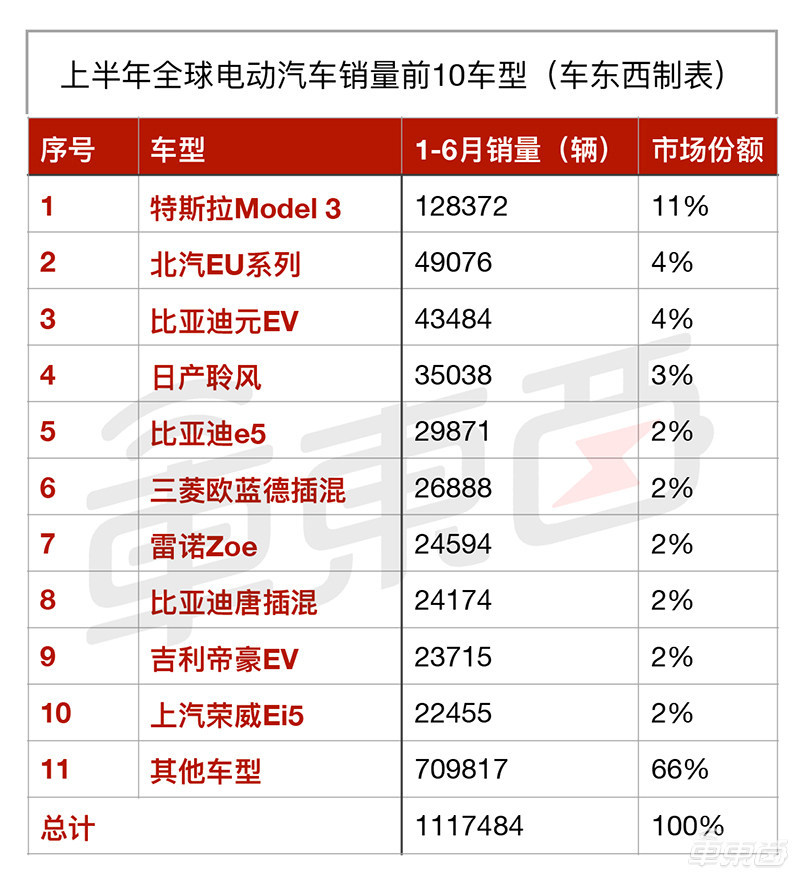
Top Ten Sales Models of New Energy Vehicles in the World
Judging from the sales volume of a single model, the top one has opened the gap with the following models such as Beiqi EU and BYD Yuan EV, and the sales volume in the first half of the year reached 128,000, accounting for 11% of the market. Judging from this momentum, the sales forecast of 500,000 this year is not impossible.
BAIC EU series and BYD EV have been sought after in the domestic market. The replacement of EC series by EU series has enabled BAIC to take off the cheap and poor quality "hat" and successfully realize the replacement of ace models. Yuan EV will also launch the modified Yuan EV535 this year. At that time, it can be expected that these two national electric vehicles will once again stage the "King’s Battle".
In addition, in terms of vehicle sales, China’s new energy vehicles occupy six seats in the top ten list of global vehicle sales, which shows the rapid development of China’s new energy market.
Looking closely at the sales list, we can also find another force-the models of the alliance also appear in the sales list of a single model, which shows that the synergy brought by the alliance is still very considerable.
3. Top ten models of global pure electric vehicle sales.
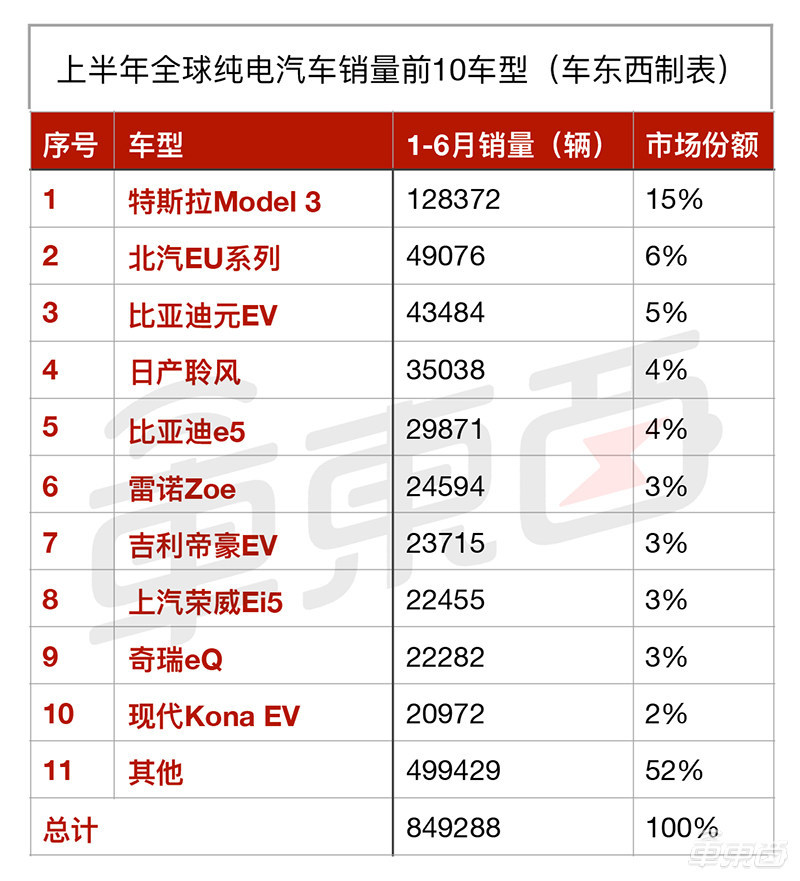
Top ten models of global pure electric vehicle sales
It is also worth noting that the market share of pure electric vehicles in the first half of this year has also been greatly improved. In June this year alone, the growth rate of pure electric vehicles reached 104% year-on-year, while the growth rate of plug-in vehicles was 67%. Pure electric vehicles accounted for 76% of the new energy vehicle market in June, compared with 69% in December last year. It has become an irreversible trend for cars to move towards pure electrification.
There is not much difference between the sales volume of a single vehicle in the pure electric market and the overall sales volume of new energy vehicles. Tesla is still at the top of the list, and China’s new energy vehicles are on the list with six vehicles. After removing the hybrid models of Mitsubishi and BYD, Korean car companies can barely make the list.
There is a magical phenomenon in the electric vehicle market in the United States. In the first half of this year, the total sales volume of electric vehicles in the United States was 175,000 units, while Tesla sold nearly 100,000 electric vehicles, accounting for 57% of the market. The sales of the remaining local brands Chevrolet, Chevrolet, and Chevrolet are somewhat stretched.
1. Top ten manufacturers of new energy vehicles in the United States
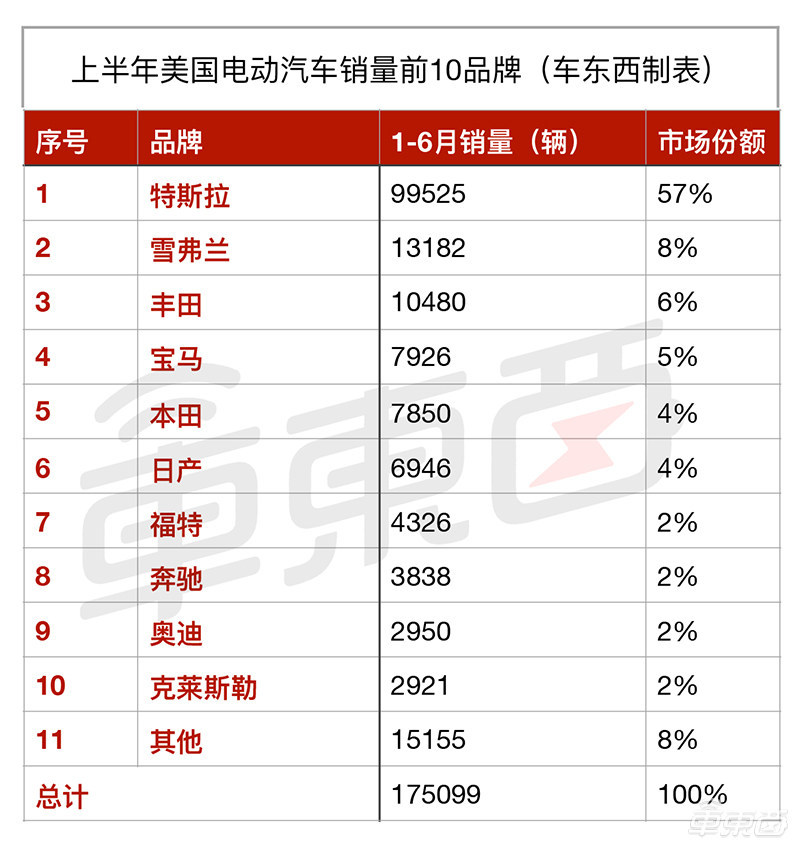
Top ten manufacturers of new energy vehicles in the United States
From the perspective of brand sales, the electric market in the United States tends to be unipolar, and the strong Tesla is in sharp contrast with the weak traditional American car companies.
In addition, the occupation of the market by foreign car companies has also affected the American electric vehicle market to some extent. Japanese car giants, Nissan, and BBA, the top three German car companies, are all trying to open up new energy markets in the United States, although these car companies have gained a place. However, from the sales results, it is still difficult for these car companies to shake Tesla’s position in a short period of time.
2. Top 10 models of new energy vehicle sales in the United States
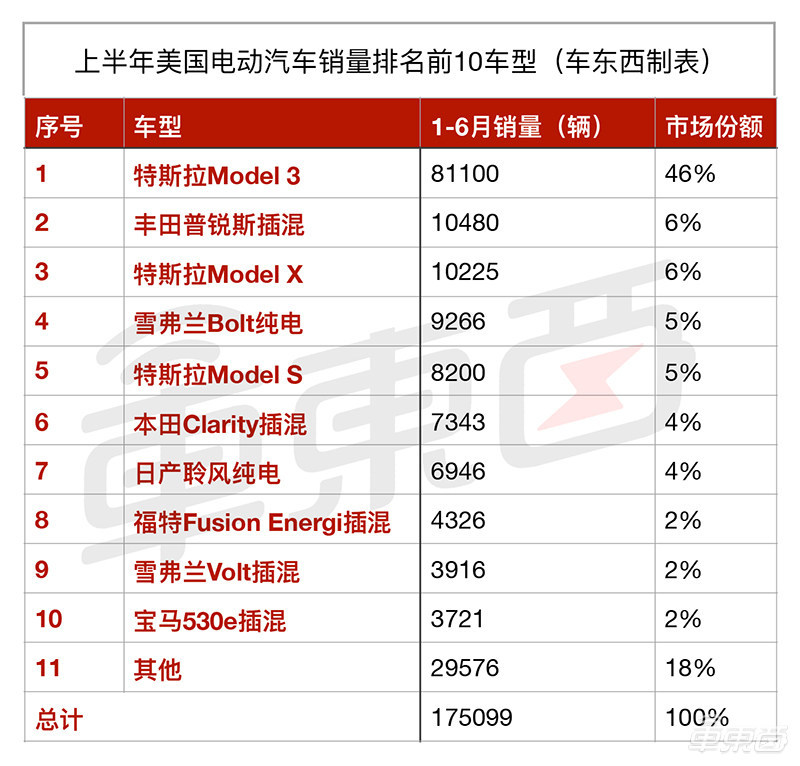
Top Ten Sales Models of New Energy Vehicles in the United States
From the perspective of single vehicle sales, Tesla’s Model 3 is also the main vehicle in the new energy market in the United States.
Interestingly, however, the new energy market in the United States seems to be somewhat against the trend of pure electricity. Among the top ten new energy vehicles, five are plug-in new energy vehicles, of which Toyota plug-in even ranks second.
In addition to Tesla, are there any models worth talking about in the US new energy market? Actually, there are, and there are two models.
First of all, we should pay attention to Chevrolet Volt, which was born in 2008. The first generation model is a model, and it has been delivered in mass production since 2010. In 2015, the model was redesigned from the inside out. After the redesign, the Chevrolet Volt became a plug-in model, and then it was listed in China under the name of Velite 5.
It can be considered that plug-in hybrid technology has given Chevrolet Volt a new lease on life, and made it on the top ten list of electric vehicle sales in the United States.
Secondly, the sales of BMW 530e (domestic BMW 530Le) in the United States are very eye-catching, and this model also has good sales in Europe and China. At the same time, this is the only model in Europe whose sales volume of a single model has entered the top ten in the US list. As a representative of luxury new energy vehicles, the BMW 530e can be said to be deserved.
The pattern of European new energy vehicle market is diversified as a whole, which is in sharp contrast with the single polarization of the United States.
The new energy vehicles of American, Japanese, European and Korean four-series car companies are "as close as a bee" in this region, and Tesla, as the representative of American new energy vehicles, is exported to Europe and won the first place. Only BMW has a voice in the European market of German Sanjie BBA; The sales volume of Renault-Mitsubishi-Nissan Alliance is also firmly in the first echelon of new energy sales in Europe; The two modern Korean brands have also reached the top ten in the European new energy sales list, which can be said to be a lot of bright spots.
1. Top ten European manufacturers of new energy vehicles.
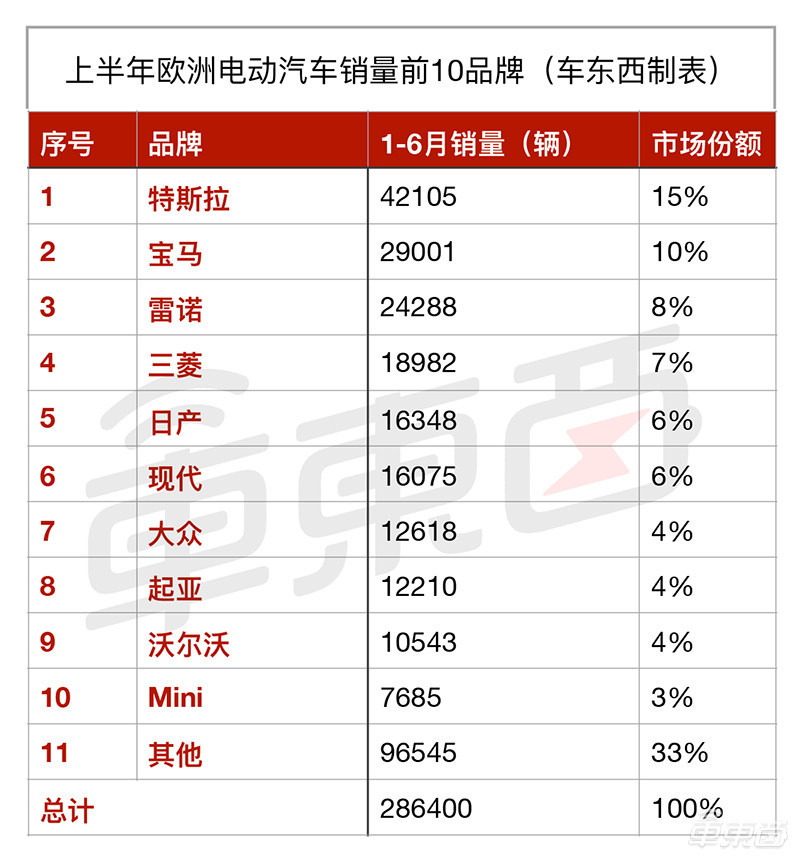
Top ten European manufacturers of new energy vehicles
From the perspective of brand sales, Tesla undoubtedly won the first place in new energy sales in Europe, but Tesla’s victory actually depends on Model 3, which entered Europe this year. This model sold 37,780 vehicles in just a few months. If you only rely on the previous and, it is difficult for Tesla to enter the top ten of the list, which shows that the competitiveness of Model 3 is very strong.
In addition, the sales of new energy brands in Europe are still supported by established traditional car companies.
BMW won the second place in Europe with its huge hybrid car series and the best-selling i3, but i3 has entered the end of the product cycle, and BMW urgently needs an ace pure electric vehicle to inherit the sales of i3.
The total market share of Renault-Mitsubishi-Nissan Alliance has reached 21%. From the perspective of automobile enterprise groups, this alliance should be the best-selling automobile enterprise group of new energy vehicles in Europe. However, the single sales of these three companies are not brilliant, and Renault has only sold 24,000 vehicles at the most. Mitsubishi and Nissan’s new energy vehicles have entered the European market only through the alliance with Renault.
It is also noteworthy that Hyundai and Kia, two Korean brands, have also entered the new energy market in Europe, and the sum of these sales is almost the same as that of BMW, which shows that Korean new energy vehicles are quite influential in Europe.
2. Top 10 sales models of new energy vehicles in Europe
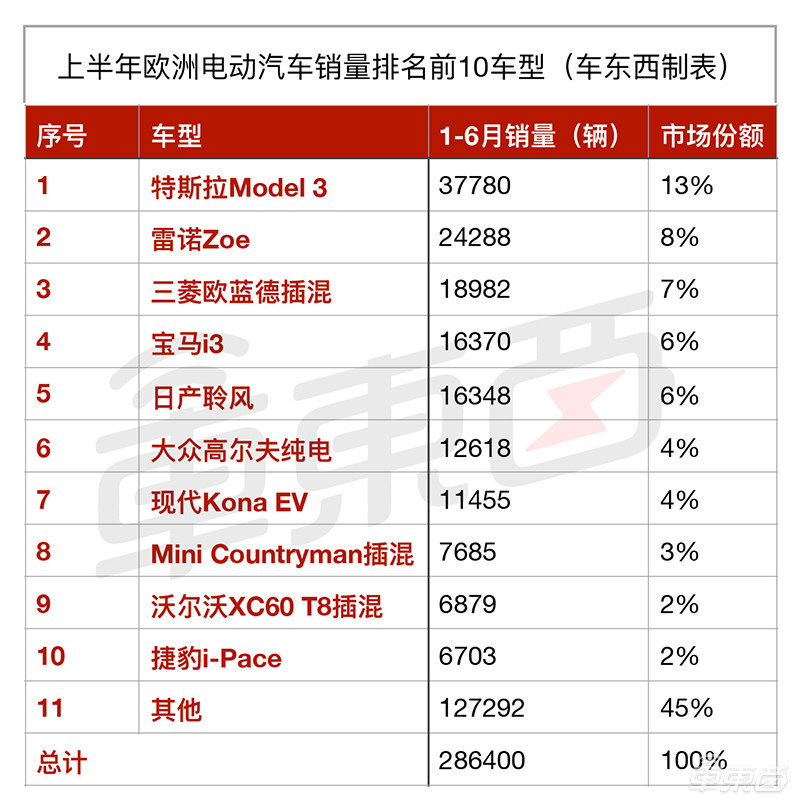
Top Ten Sales Models of New Energy Vehicles in Europe
Judging from the sales volume of a single model, Model 3 is the biggest dark horse in the new energy market in Europe this year. Before the launch of this model, no one expected that it would threaten the status of being mixed with Mitsubishi Outlander, and no one thought that this model would be more than the new energy sales of BMW’s entire group.
However, outside this model, the ranking of other new energy vehicles has hardly been affected. Renault Zoe and Mitsubishi Outlander are still evergreen trees in the European new energy market, and they sold 24,288 vehicles and 18,982 vehicles respectively.
Followed by BMW’s i3, but this model is already at the end of the product cycle, and its sales volume has been declining in recent years; Correspondingly, it is pure electric golf. Soon after its new listing, this model entered the top ten of the sales list, with a total of 12,618 vehicles sold in the first half of this year. The positioning of the two models is quite similar, and they are both miniature electric vehicles for commuting in cities, so there is bound to be some competition.
Hyundai Kona EV has also entered the top ten of the new energy sales list in Europe. Korean car companies can be said to have entered the European market with new energy vehicles. In the previous era of fuel vehicles, the sales of Hyundai and Kia in Europe have always been very general. However, it is worth noting that this electric car just bombed one in Montreal, Canada at the end of last month, and will be listed in China in the second half of this year. Quality problems may affect the subsequent sales of this model.
Mini Countryman plug-in models also performed well in the first half of this year. Previously, BMW Group has been trying to electrify the brand, and also released the pure electric version of Mini Cooper SE. This time, Mini Countryman’s entry into the top ten of the list is a good start for the mini brand. If the follow-up models can keep up, the road to electrification of the mini brand will be much easier.
On the whole, the new energy market pattern in Europe is very diversified, and the four-series car companies of the United States, Japan, Europe and South Korea have started a "big melee" in this region.
Different from the situation of new energy vehicles of various automobile enterprises in Europe and America, the domestic new energy market pattern is relatively clear.
1. Top ten manufacturers of new energy vehicles in China.
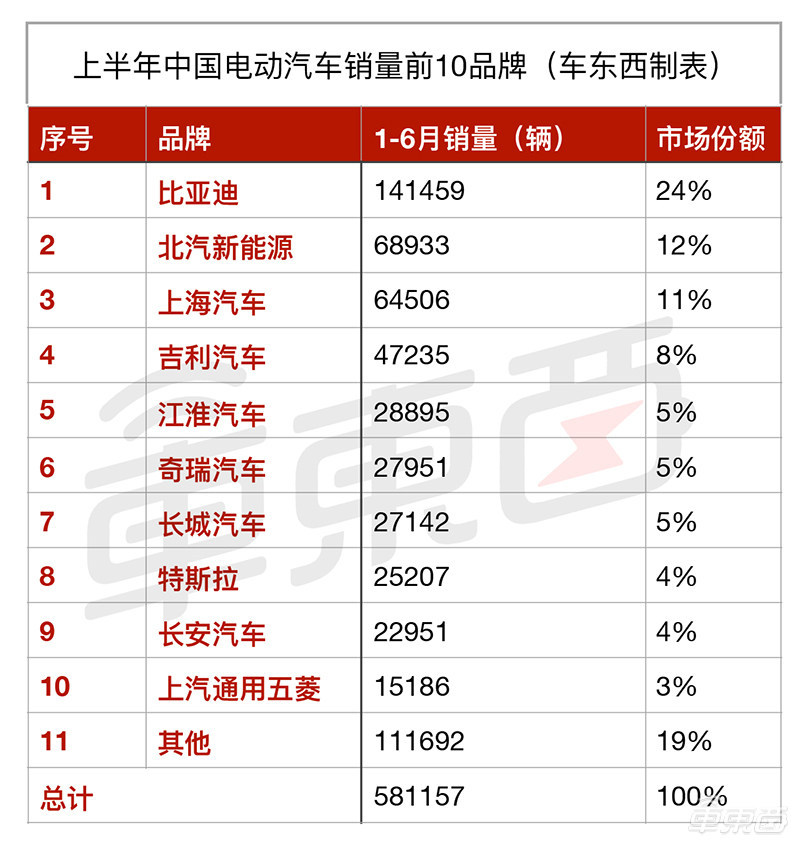
Top ten manufacturers of new energy vehicles in China
On the whole, local brands in the domestic new energy market are relatively strong. Except Tesla, no other foreign brands have entered the top ten of the new energy vehicle brand list.
In terms of brand sales, BYD is far ahead with the advantage of 140,000 vehicles, accounting for 24% of the domestic new energy market. Its main models include not only the best-selling pure electric models such as Yuan EV and e5, but also the plug-in models such as Yuan DM and Song DM. The strategy of pure electric plug-in and two-legged walking gives BYD the confidence to compete with Tesla in total sales.
The battlefield with less than 100,000 vehicles is very tight with SAIC. They sold 69,000 vehicles and 65,000 new energy vehicles respectively in the first half of this year. Among them, BAIC still relies on its own pure electric vehicles to support sales, and the performance of SAIC Roewe’s plug-in models in the first half of this year is also remarkable.
It can be seen that Beiqi pure electric vehicles are selling well in China, but at this stage, pure electricity and plug-in in the new energy market are very important for occupying the market.
After the fourth place, the sales of various car companies are relatively balanced, and the overall results are between 15,000 and 50,000. Geely is currently ahead of Jianghuai and a little bit, but the performance of Geely’s new energy vehicles is not good in July, with a drop of nearly 70% from the previous month. The new energy vehicles of Jianghuai, Chery, Dalian and other car companies in the back row may catch up at any time.
In addition to domestic car companies, Tesla’s ranking in the top ten of the domestic new energy sales list is another highlight. Previously, Tesla only had Model S and Model X models in China. Since this year, Model 3 has only been sold in China. In just half a year, Model 3 sold 13,410 units and became the best-selling new energy vehicle in China.
With the completion and commissioning of Tesla’s Shanghai factory at the end of this year, the new Tesla Model 3 and its follow-up models will be sold in China. As the price drops, Tesla may win more markets and even threaten the position of the head company in the domestic new energy market.
In addition, the new car-making forces that were quite hot before were not on the list this time. It is understood that as of June, Weimar, Tucki, and other companies have delivered less than 10,000 vehicles, which is far from the 15,000 vehicles of the tenth SAIC-GM.
2. Top ten models of new energy vehicles in China.
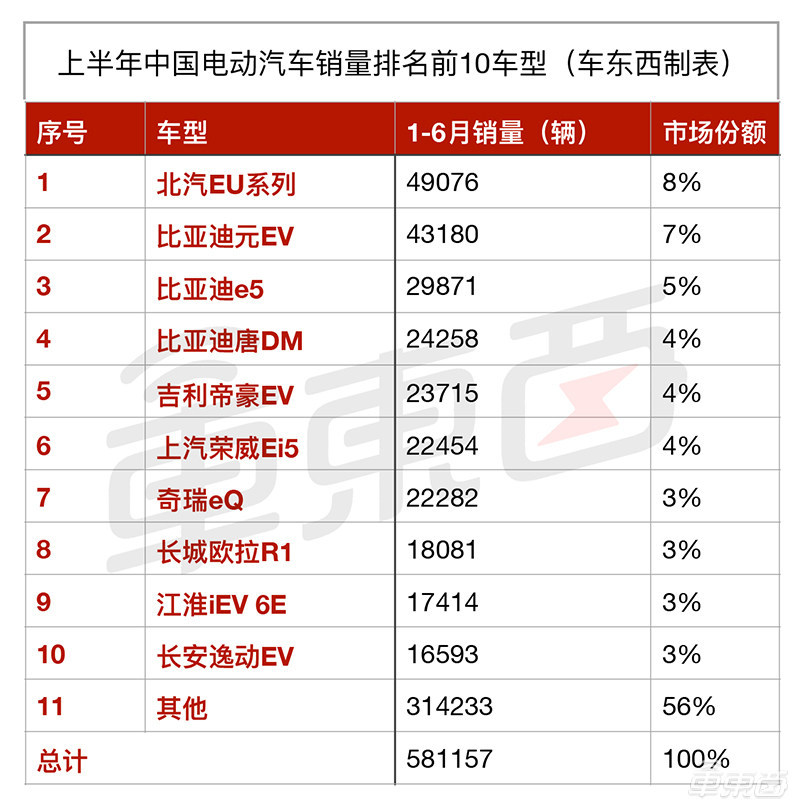
Top Ten Sales Models of New Energy Vehicles in China
Although brand sales are far ahead, BYD’s single-model sales have been overwhelmed by Beiqi EU series. In the first half of this year, Beiqi EU series sold a total of 49,000 vehicles, while BYD Yuan EV sold 43,000 vehicles.
Compared with last year, BAIC’s trump card model has been iterated from the "brand-occupying artifact" EC series to the EU series, and the product technical strength has increased. However, the sales volume of BYD Yuan EV is still closely following, and it is ready to replace the top position of Beiqi EU series at any time. In addition, BYD Yuan EV535 will be listed soon. If this model is also included in the sales volume of Yuan EV series, BYD Yuan EV is likely to counterattack Beiqi EU series to win the sales champion of a single model this year.
In addition, compared with BAIC’s strategy of "eating fresh food all over the sky", BYD also chose the stable strategy of "flowering more". In addition to the first Beiqi EU and the fifth Geely, BYD took the second, third and fourth place in the top five sales list. It is worth mentioning that BYD Tang DM is the only hybrid model in the top ten of the new energy sales list in the first half of this year, which shows that this model is very competitive.
In addition, JAC iEV 6E and Chang ‘an are all new players on the list this year, replacing the previous ones, Jiangling E200S and Geely.
As the main pure electric vehicle of Great Wall, Euler R1 entered the top ten list for several months this year, paving the way for the subsequent electrification transformation of Great Wall.
Tesla, as the only foreign car company that entered China with pure electric vehicles, has entered the top ten in terms of brand sales, but its single vehicle has not entered the top ten list.
3. Top ten manufacturers of pure electric vehicles in China.
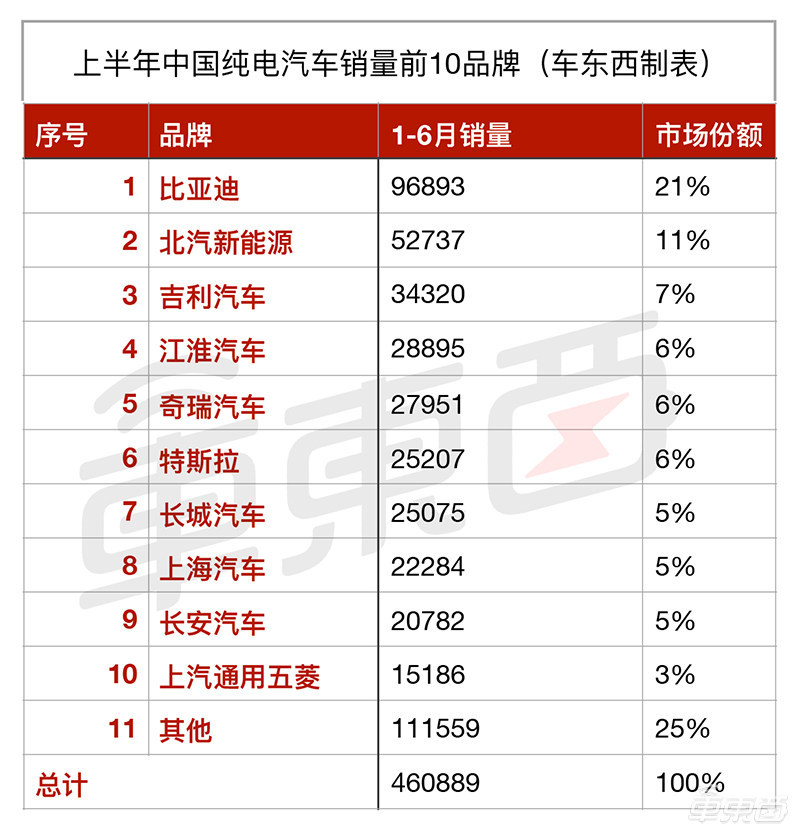
Top Ten Manufacturers of Pure Electric Vehicles in China
Judging from the top ten of the new energy sales list, domestic pure electric vehicles are obviously more popular, and nine of the ten models are pure electric vehicles. The further increase in the market share of pure electric vehicles also means that the speed of domestic automobile electrification transformation is further accelerated.
It is also for this reason that the gap between the domestic pure electric list as a whole and the new energy list is not large. In terms of brands, SAIC and other car companies that mainly sell new energy vehicles with plug-in models have declined, and Tesla’s ranking has further increased. However, BYD still maintains the number one position in brand sales because of its many categories and sales of pure electric vehicles.
4. Top ten models of pure electric vehicles in China.
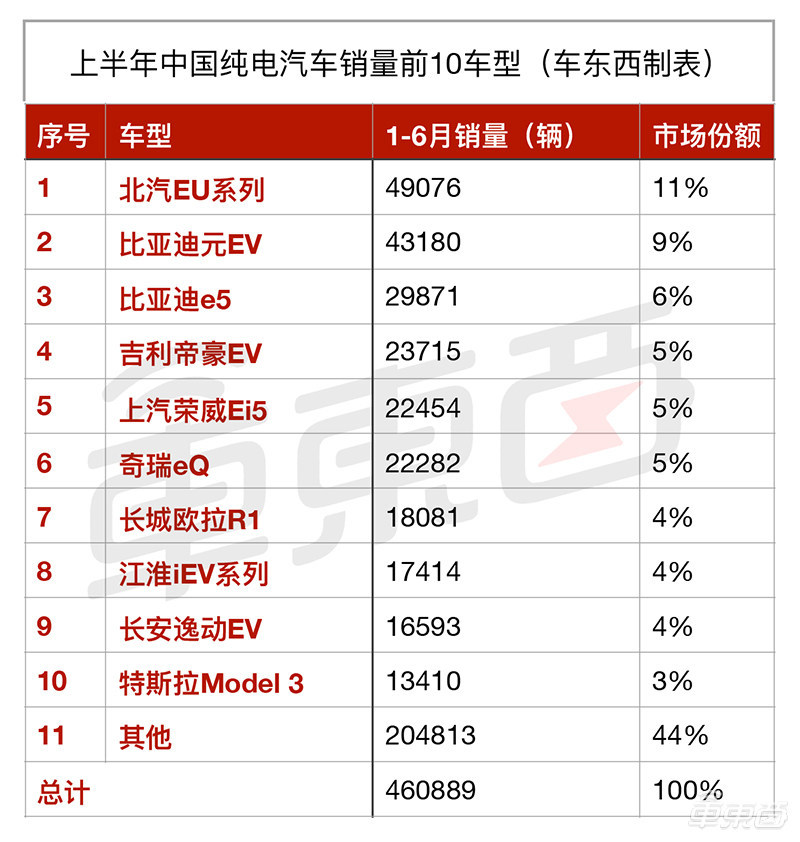
Top Ten Sales Models of Pure Electric Vehicles in China
In terms of the sales volume of single pure electric vehicle, there is almost no overall change. Due to the removal of BYD Tang DM, the Tesla Model 3, which was originally ranked 11th in the sales volume of new energy, ranked 10th in the sales volume of single pure electric vehicle.
In addition, Tesla Model 3 is the only high-end model among the top ten pure electric sales lists, which shows that this model is still very competitive.
5, China plug-in car sales top ten manufacturers.
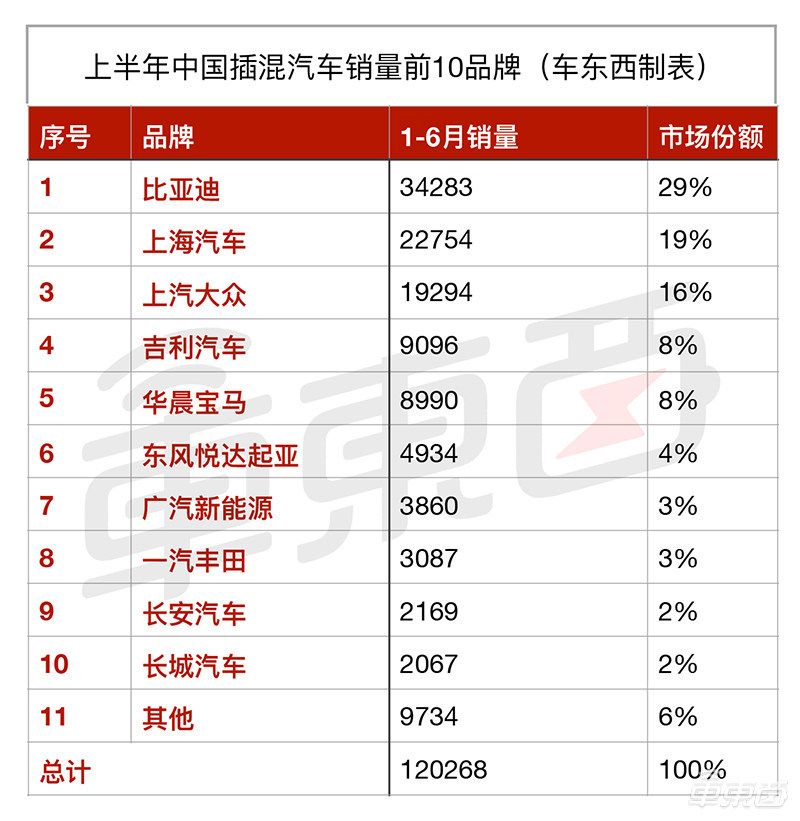
Top Ten Manufacturers of Hybrid Cars in China
In terms of mixed brands, BYD still ranks first in brand sales (hot-selling models are mostly willful), and the second place is SAIC, which sold 22,754 vehicles, and its sales performance with eRX5 in the first half of this year is good.
In addition, some of the top ten positions in China have been seized by joint venture car companies, and joint venture car companies such as SAIC-Volkswagen, BMW Brilliance, Kia of yueda and Toyota all have certain sales in the field of plug-in. However, except for the Passat of SAIC Volkswagen, the sales of other car companies exceeded 10,000 units.
6, China plug-in car sales top ten models.
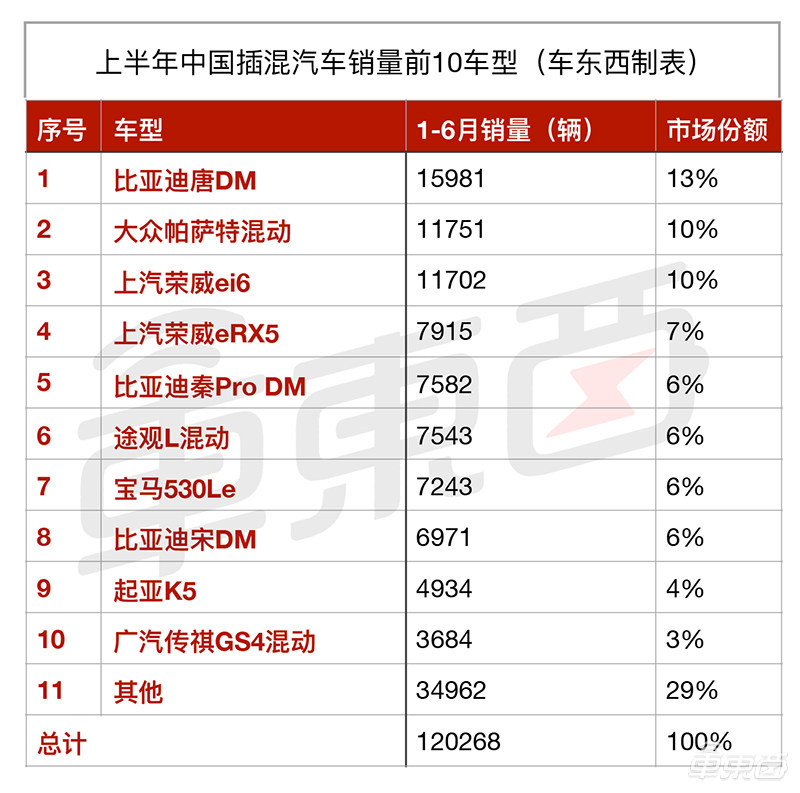
Top 10 sales models of hybrid cars in China
Judging from the top ten plug-in hybrid models in sales volume, Tang DM is worthy of being BYD’s ace plug-in hybrid model, and its sales volume has surpassed more than 4,000 Volkswagen Passat in the second place. It is understood that this model will also launch a dual-engine four-wheel drive version in the near future, and the product strength will be upgraded again.
The plug-in version of Volkswagen Passat has not been launched for a long time. Because Passat, the "National God Car", had a good reputation and user base before, the plug-in version became a best-selling model, and its sales in the first half of this year exceeded 11,000.
As the main plug-in hybrid model of BMW, BMW 530Le also sells well in China, and a car with more than 500,000 vehicles can sell 7,243 vehicles in China, which shows that the product strength of this model is very strong.
At present, China, the United States and Europe are the three largest new energy vehicle markets in the world, but the new energy market patterns in the three regions have their own characteristics.
1. Comparison of the Top Ten Sales Models in China, America and Europe
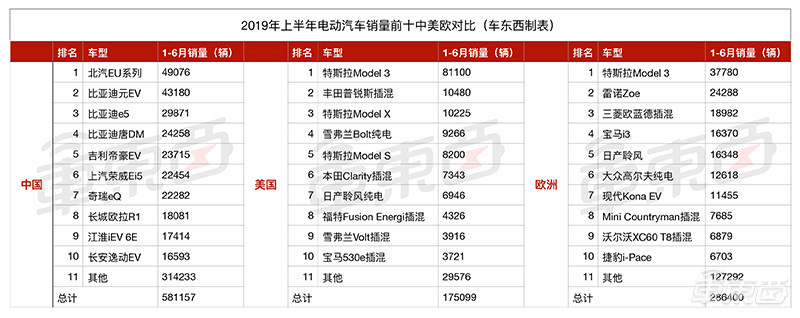
Comparison of Top Ten Sales Models in China, America and Europe
From the overall sales situation, China is the largest new energy vehicle market at present. In the first half of the year, the total sales of new energy vehicles in China exceeded 580,000, accounting for nearly 50% of the global sales of new energy vehicles. Compared with China, the sales volume in Europe and America is relatively small, but it is also in a state of continuous growth.
From the perspective of a single model, the best-selling new energy vehicle in Europe and America is Tesla’s Model 3, especially in the United States, where the sales of 81,000 vehicles have opened a considerable gap between Model 3 and the second Toyota Prius. However, in China, Tesla did not achieve a good market, so that it did not squeeze into the top ten.
In the price distribution of best-selling models, China, the United States and Europe are also different. Most domestic best-selling new energy vehicles are located in the price range of 100,000-200,000, and car companies are more inclined to the mid-end consumer market when pricing; On the top ten list of new energy vehicles in the United States and Europe, luxury brands such as Model X, Model S and Volvo XC60 T8 are also on the list. This phenomenon mainly reflects the different purchasing power of consumers in different regions.
2. Comparison of the top ten brands in China, America and Europe.
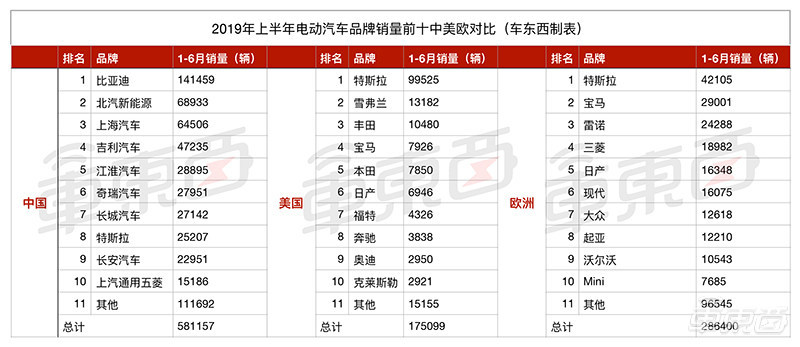
Comparison of Top Ten Brands in China, America and Europe
From the brand sales in the three regions, China local car companies have obvious advantages in new energy brands, while Europe and America tend to be more diversified. The American market is mainly occupied by local car companies such as Tesla, Ford, Chrysler, Toyota, Nissan, Honda and BBA German top three. Europe, on the other hand, presents a situation of scuffle between the United States, Japan, Europe and South Korea.
However, it is worth mentioning that the sales of new energy vehicles in the United States are highly polarized, with Tesla taking the lead, occupying 57% of the market, while the sales of other models are low, which shows that the products of new energy vehicles currently available in the new energy market in the United States are weak. However, if the time line is lengthened, the potential of the new energy market in the United States is also very great. The huge automobile consumers determine the base of its new energy market, while new car companies such as Rivian and Lucid, as well as established car companies such as Ford and General Motors, will have great room to play in the electrification market in the future.
In contrast, the distribution of sales in China and Europe is relatively even, with the sales of a large number of vehicles in the China market ranging from 10,000 to 30,000, and the same is true in the European market.
From the above 15 tables, the global new energy vehicle market can be summarized as follows:
1. The growth rate of the global new energy vehicle market has reached 46% (year-on-year growth) and entered a high-speed growth stage. If this speed can be maintained, the global sales of new energy vehicles are likely to exceed 3 million this year.
2. Pure electric vehicle has surpassed plug-in hybrid to become the main new energy vehicle, and the growth gap between them is further widening, and the trend of transition from new energy vehicles to pure electric vehicles is still clear.
3. The European and American markets are diversified, and Tesla ranks first in global sales, ranking first in Europe and America. However, in the domestic market, which is more cost-effective, Tesla’s sales are not at the top.
4. The advantages of local brands in China’s new energy market are obvious, and BYD and BAIC have carried the banner of China’s new energy market.
5. China’s new energy market accounts for half of the global share, and its position is increasingly prominent. With the further opening of the automobile industry environment, China will become the most important new energy automobile market in the world.