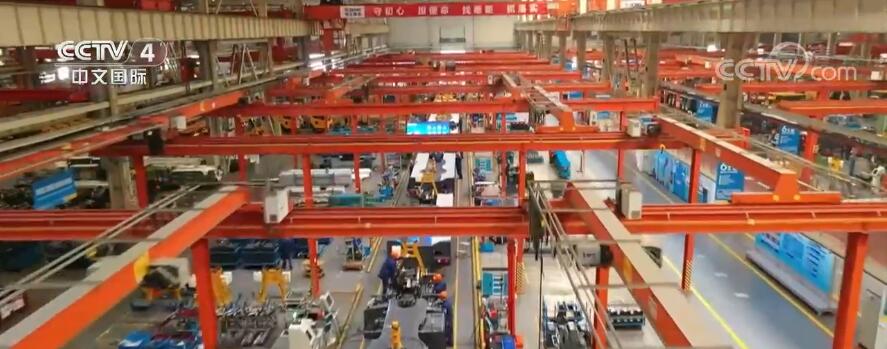
With the outbreak of AI mobile phone PC, Arm has made efforts from software and hardware to ecology, creating an industry AI treasure chest.
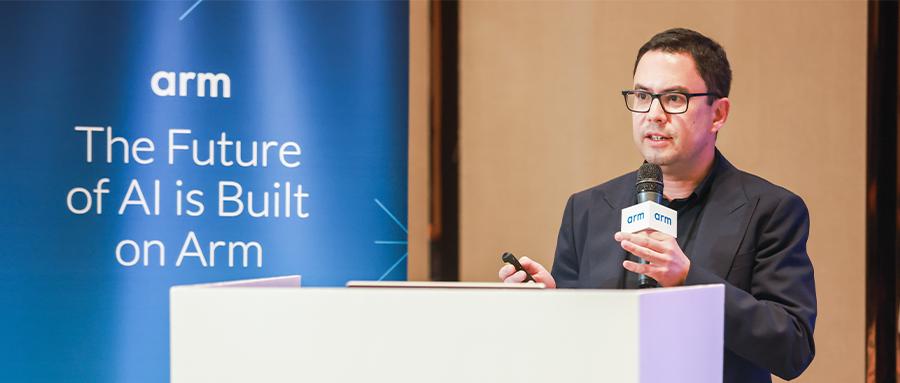
Generative AI, Arm throws AI software and hardware to accelerate the whole family bucket.
Author | Yun Peng
Edit | Desert Shadow
With the advent of the "Gen-AI" era, key mobile devices such as AI mobile phones and AI PC are rapidly combining with generative AI, and more and more new AI functions are emerging, which has a profound impact on our lives and work.
Demand has become diversified, and the scene has become more complex. Generative AI brings new computing challenges and storage challenges, and accelerates a series of technical iterations in hardware, software, algorithms and ecology.
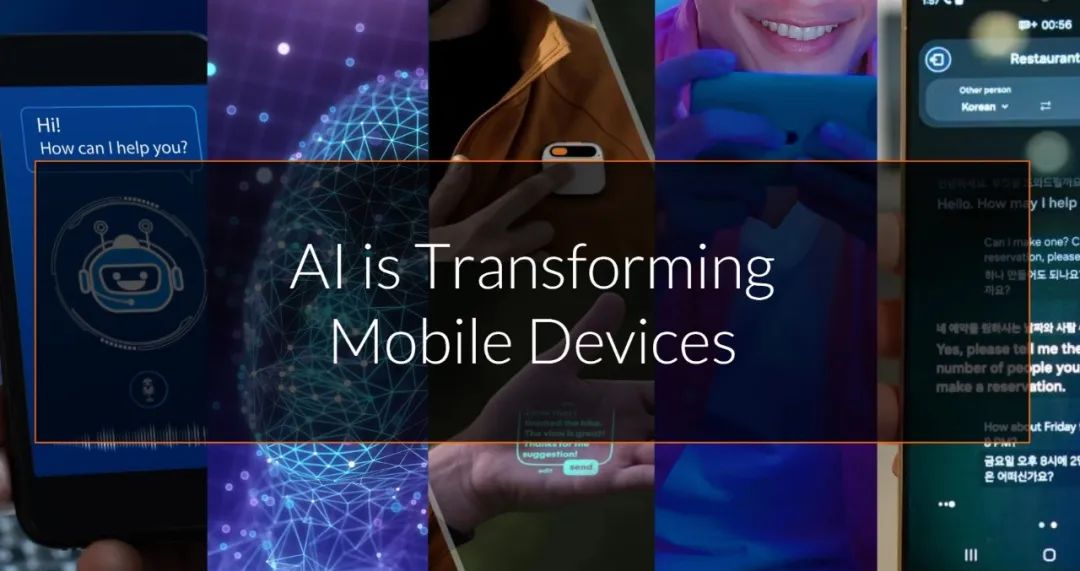
As the "foundation" provider of all mobile computing, Arm is also actively exploring new solutions and bringing new solutions to the industry.
In recent years, Arm has gone beyond providing IP, from architecture, hardware and software to ecology. Arm has transformed into a computing platform company, providing complete computing solutions for the industry.
For cloud data centers and automotive applications, Arm has successively launched corresponding computing subsystems (CSS). Just last week, Arm released the first terminal computing subsystem (CSS) for the terminal equipment market, combining the characteristics of the latest Armv9 architecture, in which both CPU and GPU have greatly improved their performance in AI. In addition, Arm also tailored the development tool Kleidi for developers.
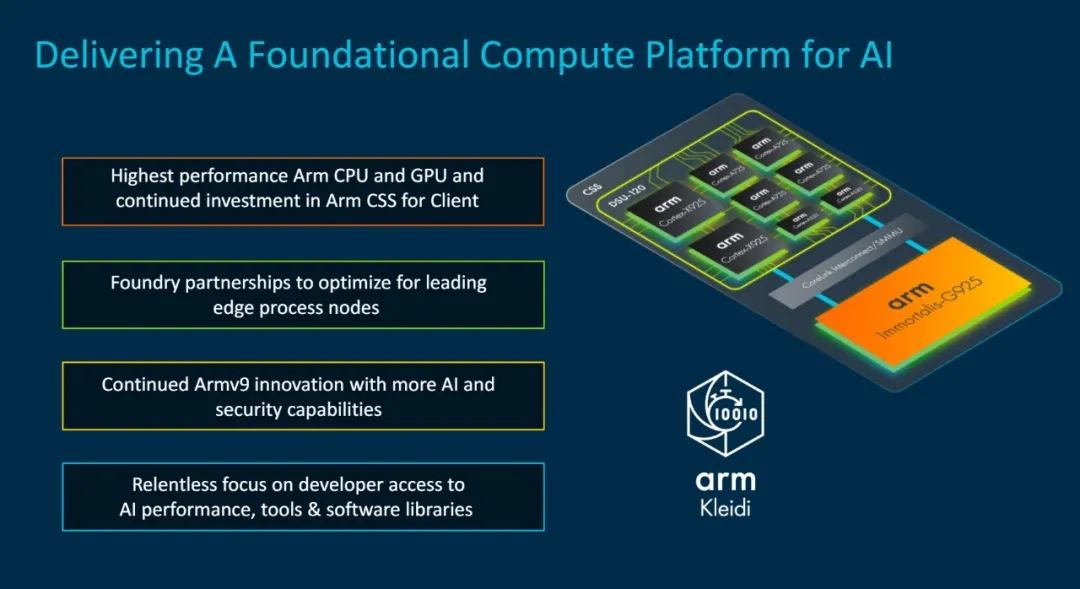
This year, Arm has been upgraded from TCS to CSS. The main difference between them is that Arm provides physical implementation of CPU and GPU for the first time, which makes it easier to build and deploy solutions based on Arm architecture. Obviously, this change is precisely to enable ecological partners to quickly grasp new opportunities in AI and accelerate the process of product listing.
It can be said that this is undoubtedly a key force for Arm to face the AI era. This series of heavy technologies and new products of Arm are aimed at the end-side AI.
James McNiven, vice president of product management of Arm Terminal Division of Zhixi Dialogue, made a deep exploration of the key breakthrough behind it and discussed the layout and in-depth thinking of Arm in the era of generative AI.
We can clearly see that Arm is making its partners’ products quickly combine with AI and bring them to market through a complete solution spanning architecture, hardware, software and ecology, so as to achieve landing and create an "AI treasure chest" for the industry.
01.
The wave of mobile-generated AI surges, and Arm goes deep into the bottom.
From architecture to software and hardware empowerment
In today’s smart terminal industry, AI mobile phone and AI PC have undoubtedly become the focus of the industry, and the integration of generative AI in these two fields is also the fastest. The tasks that terminal devices can handle are becoming more and more complex, and generative AI has brought brand-new technical challenges in perception, understanding and interaction, and more computing requirements have emerged.
The industry needs to rethink: what is a computing platform suitable for the generative AI era?
Nowadays, the operation of all mobile generative AI is almost inseparable from the CPU and GPU of Arm. It is understood that 70% of the third-party Android ML workloads are running on the CPU, so the CPU is still the core of computing in the AI era.
In this context, Arm, as the provider of the underlying key technologies, has undoubtedly become a key variable in this AI revolution.
1. Behind the significant improvement of AI capability, Arm’s "DNA" fits with generative AI.
Why is it so critical? The AI era has brought many challenges, the most obvious of which is that the importance of high performance and energy efficiency has been placed at an unprecedented height, and energy efficiency is precisely the DNA of Arm.
The new terminal CSS is based on the latest Armv9, and its computing and graphics performance is improved by more than 30%, while its AI reasoning speed is increased by 59%. These improvements are very important for handling more demanding Android practical use cases and AI, ML and computational vision workloads.
The main frequency of the new Arm Cortex-X925 with 3nm technology soared to 3.8GHz. With the improvement of micro-architecture, compared with the 4nm SoC adopted by the flagship smartphone in 2023, its single-thread performance improved by 36%.
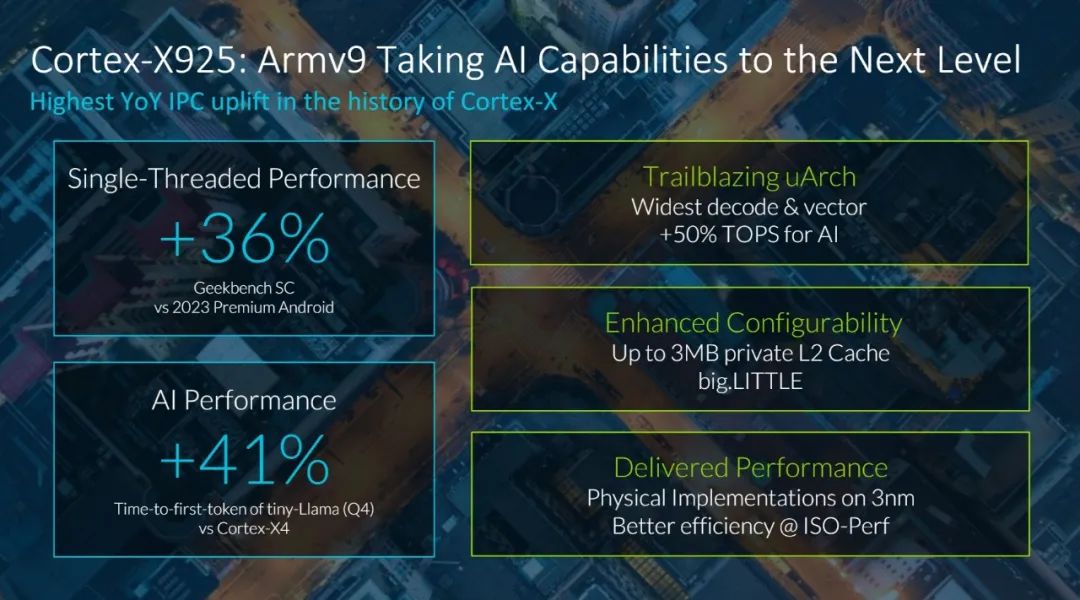
In terms of AI performance, the first response time of Cortex-X925 token is improved by 41%, which can improve the response ability of end-side generative AI such as large language model.
McNiven revealed that in order to improve the computing power of AI, Arm has adopted the widest decoding and vector micro-architecture design so far, achieving a 50% increase in TOPS number.
On the GPU side, the new Arm Immortalis-G925 GPU has achieved 37% performance improvement in various head mobile game applications and 34% performance improvement in multiple AI and ML networks.
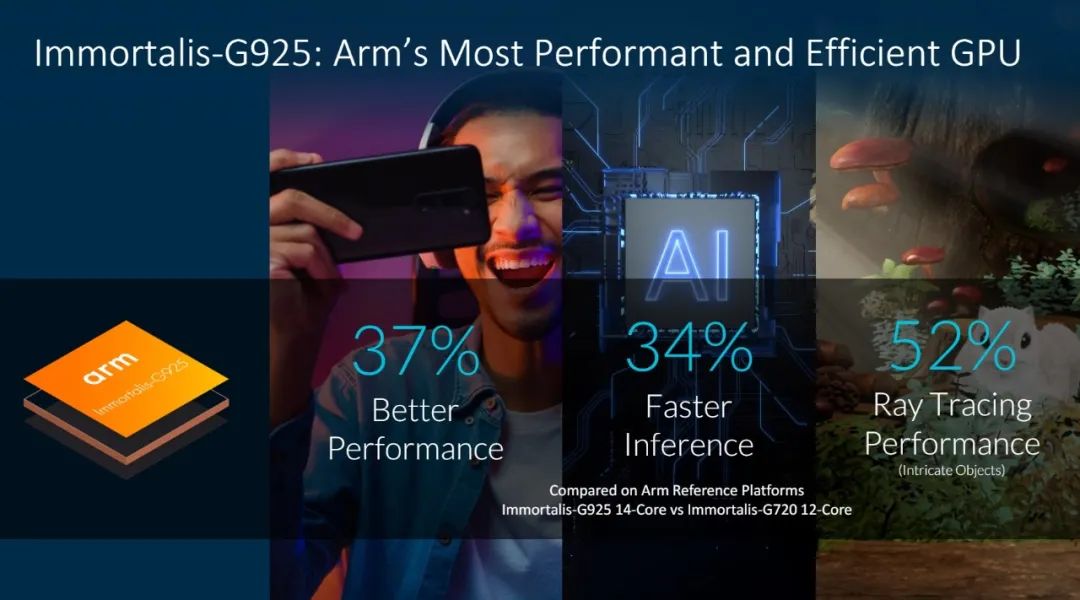
It is worth mentioning that the Arm terminal CSS also has the physical realization of CPU and GPU based on 3nm process.
It is understood that the physical realization, including the design and wiring of transistors, can significantly help Arm partners to save chip development time and optimize chip performance and energy efficiency.
2. Create a "key" for developers to unlock stronger performance.
In addition to architecture and hardware design, in terms of tools and software libraries, Arm also released Arm Kleidi for the first time, including KleidiAI for AI workload and KleidiCV for computer vision applications.
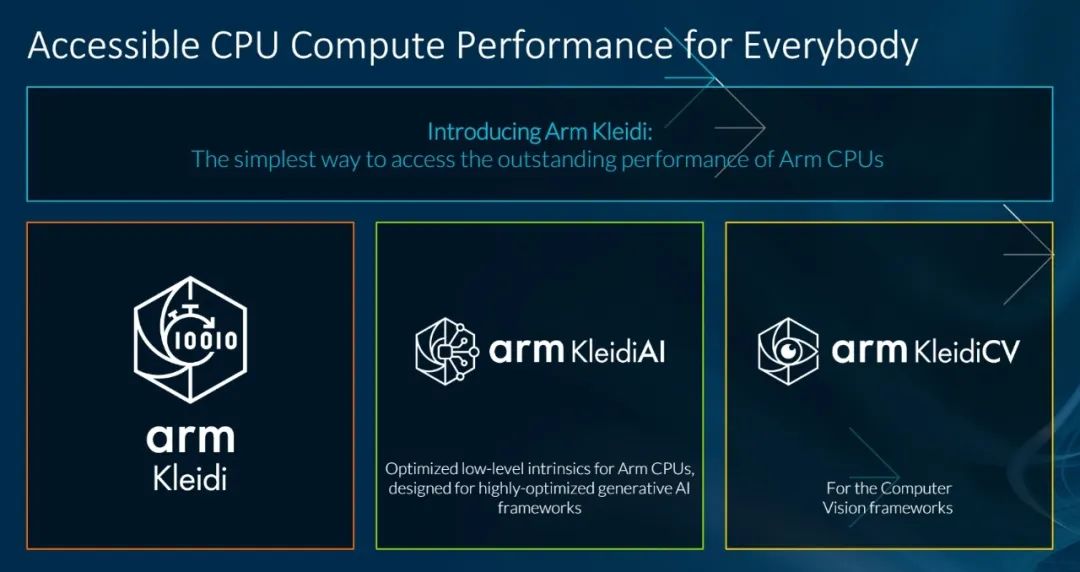
The core purpose of Arm as Kleidi is to ensure that developers can quickly obtain the performance, tools and software libraries needed to develop generative AI applications.
Simply understood, KleidiAI is a set of computing cores for AI framework developers. Popular AI frameworks such as PyTorch, Tensorflow and MediaPipe have been integrated into KleidiAI, which is very important for accelerating the mainstream AI model.
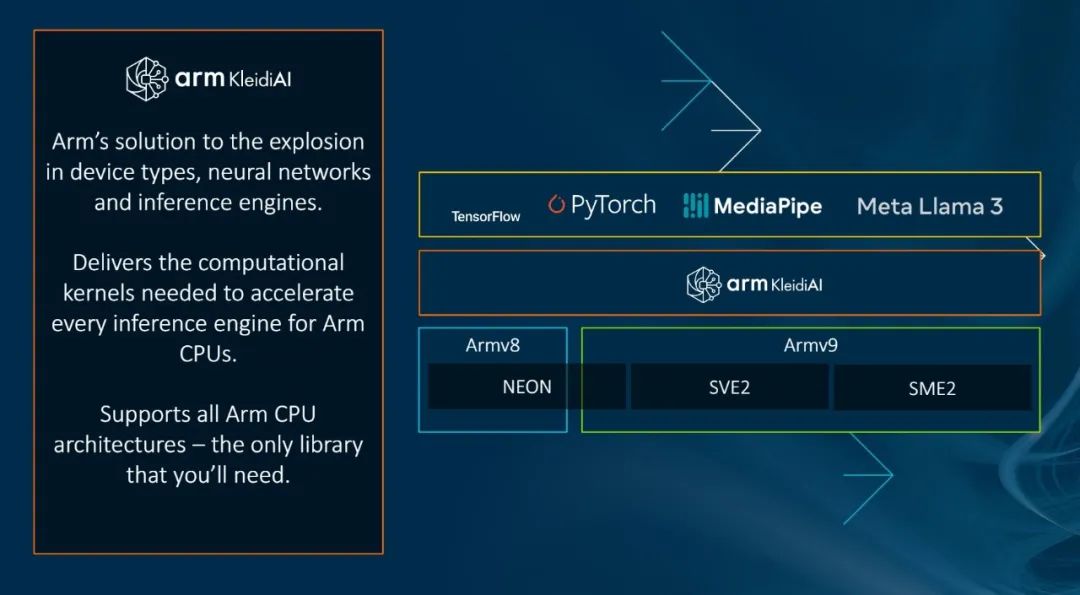
It is worth mentioning that, in Arm’s view, CPU is the only computing engine that can ensure the running of the future network, so Kleidi, which can unlock the highest performance of Arm CPU, is undoubtedly the best weapon for developers to unlock AI applications.
Generally speaking, the excellent architecture upgrade, performance and energy efficiency improvement of the Arm terminal CSS pave the way for more functional, stronger and smarter terminal devices, and expand the possibilities and capabilities of mobile devices. At the same time, Arm’s software development tools and platforms allow developers to quickly put these technical advantages of Arm into applications and products. It can be said that Arm has created a "treasure chest" for mobile AI.
02.
The popularity of AI PC accelerates the ecological growth of WoA
Mobile AI ecosystem Arm takes the lead
As mentioned above, Arm provides not only a single point technology or product, but a complete solution. Behind this, the ecological advantages based on architecture, hardware and software are also one of Arm’s hardest cards.
With the rapid development of AI mobile phones and AI PC, the Arm ecosystem has ushered in a new round of growth climax. With the strong promotion of mobile AI PC by Microsoft and other manufacturers, and the accelerated integration of Windows and Arm ecology, we will expect to see more and more PC terminal giants launch AI PCs based on Arm architecture processors.
At this week’s Taipei International Computer Show, the CEO of Arm shouted that the PC with Arm architecture will grab 50% market share in five years. A large part of this strong self-confidence comes from the explosive growth of "Arm Native".
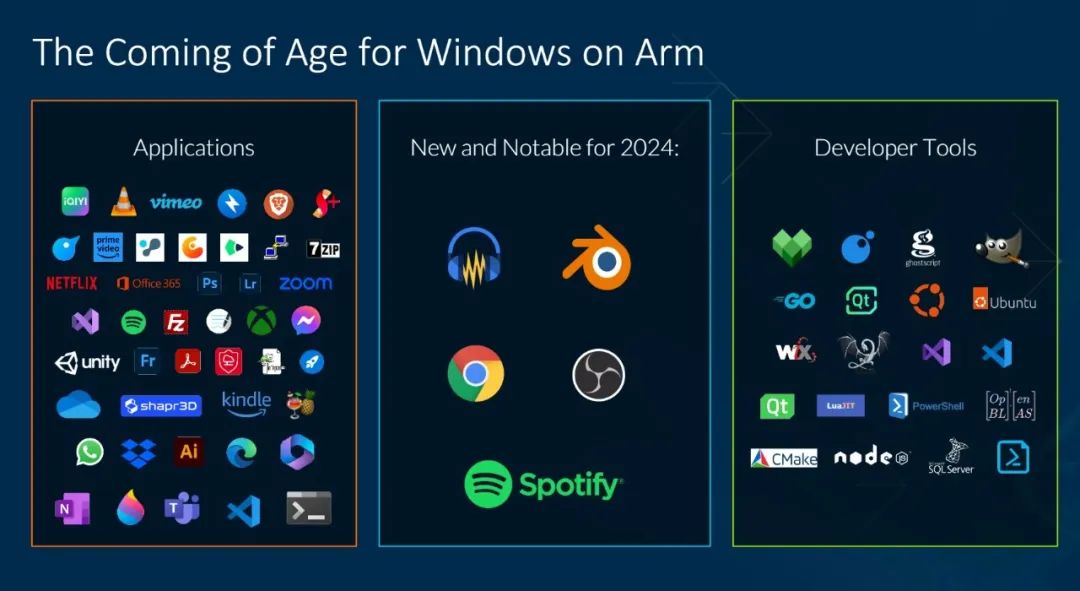
McNiven specifically mentioned that this year has been a fruitful year for the WoA ecosystem. In addition to Microsoft Office, Dropbox, Zoom and Adobe suite, more and more applications are becoming native applications of Arm, especially head applications such as Baidu, Bili Bili, Chrome browser, iQiyi, sogou and Tencent QQ Music.
In addition, there are many open source tools for creators, such as recently added Audacity, Blender and OBS Studio, which integrate a large number of open source libraries and developer tools.
Arm cooperates with Microsoft to develop the ecosystem by funding open source and publishing the Arm performance library for Windows. It is understood that for most users, they spend most of their time running Arm native applications on AI PC based on Arm CPU.
Satya Nadella, CEO of Microsoft, said at the Build conference that 87% of the existing Arm PC applications are native Arm versions, and this number is still growing.
It can be predicted that with the addition of more and more Arm native applications, the experience of Arm PC and WoA ecology will be more perfect.
It is understood that there are now more than 1,000 technical partners of Arm, and Arm undoubtedly has the "strongest circle of friends" in the chip field, and this circle of friends, more intuitively, is the Arm ecosystem-more devices are based on Arm, and more applications are based on Arm, and the AI experience of mobile terminals cannot be separated from Arm.
Ecology is one of the hardest trump cards of Arm, and Arm has also become the "behind-the-scenes king" of the mobile intelligent terminal industry.
Today’s Arm is improving the ability of enterprises and developers to quickly use AI in products, use it correctly, use it well, and achieve landing, and truly create a treasure chest of mobile chips in the era of generative AI.
03.
Conclusion: From IP to Computing Subsystem
Arm becomes the invisible king of mobile AI ecology
It can be seen that Arm is combining cutting-edge CPU and GPU technology, production-ready physical realization and continuous software optimization, and the combination of terminal computing subsystem (CSS) and Kleidi software also makes it an excellent example of a new AI computing platform in the field of chip design.
Today, Arm low-power processor design and software platform have been applied to more than 280 billion chips, from sensors to smart phones and even supercomputers. In the future when AI becomes ubiquitous, Arm will also be ubiquitous. It can be said that the Arm architecture is the cornerstone of the future, and the Arm ecosystem will continue to accelerate its growth.
Facing the future of generative AI, more innovations will inevitably emerge in the mobile intelligent terminal industry. We will wait and see how Arm will maintain its core competitiveness and continuously expand its ecology through technological innovation.
(This article is the original content of the signing account of Netease News Netease Special Content Incentive Plan [Zhizhi]. It is forbidden to reprint it at will without the authorization of the account. )
Original title: "AI mobile phone PC explosion, Arm from software and hardware to ecological efforts, to create an industry AI treasure chest"
Read the original text