"Tiangong Classroom" once again talks about exploring the wonderful space world.
Guangming Daily reporter Zhang Wen Guangming Daily correspondent Zhan Kang
March 23rd is the 159th day for the astronauts Zhai Zhigang, Wang Yaping and Ye Guangfu of Shenzhou XIII to stay in orbit. Just before the return trip, three astronauts taught the second lesson of "Tiangong Classroom" to teenagers at the China Space Station. The main classroom on the ground is located in China Science and Technology Museum, and the sub-classrooms are located in Lhasa, Xizang and Urumqi, Xinjiang. In the afternoon, the reporter walked into the China Science and Technology Museum and listened to this wonderful space science class with teenagers in the main classroom on the ground.
At 15: 44, the "Tiangong Classroom" officially started.
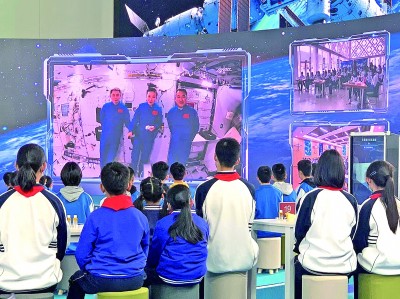
On March 23rd, in the main classroom of China Science and Technology Museum, students listened to the "Tiangong Classroom". Guangming Daily reporter Zhang Wenshe/Guangming picture
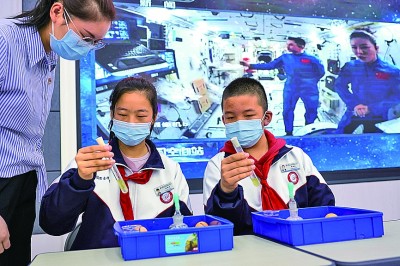
On March 23rd, in the No.70 Middle School in Urumqi, Xinjiang, students watched the second lesson of "Tiangong Classroom" and conducted an experiment of water-oil separation. Xinhua news agency
"Space exploration is endless, hello everyone, I am ‘ Space teacher ’ Wang Yaping, I’m glad we meet again. Today is our ‘ Tiangong classroom ’ Lesson 2 … …” "I am the commander Zhai Zhigang and continue to work as a photographer." "I am astronaut Ye Guangfu, and I am very happy to share the scientific knowledge in space with you again."
The familiar voice sounded, and the figure of "space teacher team" once again appeared in the "Tiangong classroom", which immediately "brought" the students into the wonderful space.
Camera one is doing an experiment of "ice and snow" in China Space Station.
Not long ago, Beijing 2022 Winter Olympics and Paralympic Winter Games made people appreciate the charm of ice and snow sports. Wang Yaping, the "space teacher", first demonstrated the experiment of "ice and snow" in space. I saw that she took out a transparent bag with supersaturated sodium acetate solution, and the mouth of the bag was connected with a straw. Then, she carefully squeezed the solution out of the bag, and after several attempts, a transparent liquid ball gradually formed at the mouth of the straw. "It’s time to witness the miracle." Wang Yaping gently touched the sphere with his hairy roots stained with a little crystal nucleus in advance, as if by magic, and the transparent ball quickly turned into a crystal ball, which looked like a "ice hockey".
"Sodium acetate solution is very soluble in water with high temperature, and it is easy to form supersaturated solution. In this solution, as long as there are a little crystal nucleus particles, it can break its stable state and precipitate a large number of crystals." Wang Yaping revealed the mystery, and when the crystals are precipitated, heat will be released, so this "ice hockey" feels hot.
In the space station, the surface tension of liquid in microgravity environment makes the extruded liquid form a full and uniform liquid ball. In order to show the students the surface tension more intuitively, Wang Yaping did the second experiment. I saw two plastic plates in her hand, and Ye Guangfu squeezed a water polo on the surfaces of the two plastic plates with a bag filled with drinking water. At the same time, the students in the main classroom on the ground are doing the same experiment. Wang Yaping put two water polo balls together until they merged, then slowly pulled them apart, and a strange liquid bridge was built.
In the main classroom on the ground, the reporter observed that the same phenomenon did not appear in the hands of the students. Chen Zheng, a member of the expert group of "Tiangong Classroom" and an associate professor of Beijing Jiaotong University, told the reporter that the liquid bridge was formed by water connecting two plastic plates under the action of surface tension. In the microgravity environment of the space station, water can form a liquid bridge with a little surface tension. On the ground, there are gravity factors, which need to be realized by using high pressure and other conditions. The experimental principles of the two are also different.
Lens 2 "Ice Dun Dun" appeared in "Tiangong Classroom"
In the subsequent buoyancy experiment in space, Wang Yaping encountered a "difficult problem". As you can see on the screen, she is holding a small bottle containing two kinds of liquids, namely transparent water and yellow cooking oil. After Wang Yaping and his classmates shook the bottles in their hands and let them stand, there was a completely different phenomenon in the classroom between heaven and earth: the liquid in the bottles in the hands of the students gradually formed layers, while the water and oil in the bottles in Wang Yaping were still mixed together.
What should we do? Wang Yaping turned to the students in the ground class for help. A classmate suggested that water and oil should be separated by means of rotation and centrifugation. Ye Guangfu, the "artificial centrifuge", immediately demonstrated that he tied the rope to the bottle mouth and quickly rotated the bottle. In a short time, the water-oil mixture in the bottle was layered.
After showing the wonderful liquid phenomenon in space, Wang Yaping began the last experiment — — Space parabolic. At this time, a small and lovely mascot of the Beijing 2022 Winter Olympics "Bingdundun" appeared in the "Tiangong Classroom". It is understood that this top-stream "teaching assistant" entered the China Space Station with the Shenzhou 13 crew last year.
I saw Wang Yaping gently push with his finger, and the "ice pier" drifted slowly to Ye Guangfu not far away. After Ye Guangfu caught it, he pushed it to Wang Yaping, and the "ice pier" made an approximate uniform linear motion back and forth between them.
"Flat throwing motion refers to the motion of throwing an object at a horizontal initial velocity and being acted by gravity without considering air resistance." Zhang Jian, the teacher of the main classroom on the ground of "Tiangong Classroom" and the physics teacher of the Second Affiliated Middle School of Beijing Normal University, told the reporter, "‘ Ice pier ’ It is possible to do approximately uniform linear motion in the space station because in the microgravity environment of the space station, objects are almost unaffected by gravity. "
Lens 3 "Space Teaching Aids" Science Experiment Cabinet debuted for the first time.
After the interesting experiment demonstration, two cool scientific experiment cabinets on the China Space Station — — The high microgravity experimental cabinet and the containerless material experimental cabinet made their debut for the first time. Through on-the-spot introduction and experimental video playback, the "space teachers" used the "space teaching aid" experimental cabinet to vividly show the progress of the space science experiment in this mission.
"Scientific experiment is an important means to help scientific research. The scientific experiment cabinet is the main facility for us to carry out scientific experiments on the space station. After the launch of the experimental chamber of the sky and the experimental chamber of the dream, more experimental cabinets will be added to carry out more scientific experiment projects in the field." Zhang Wei, director of the Application Development Center of the Space Application Engineering and Technology Center of the Chinese Academy of Sciences, said that there are more than a dozen scientific experimental cabinets in the China Space Station, such as life science experimental cabinets and microgravity fluid physics experimental cabinets, which will support large-scale scientific experiments in the future.
"At that time, Chinese and foreign scientists can rely on the experimental cabinet to carry out research, and our space station in China will become a space science platform for the benefit of all mankind." Ye Guangfu said, "Students, we also eagerly expect you to put forward your own scientific experiment ideas. Maybe next time we will show your experimental project in space."
The lens interacts with the world, and the wonderful continues.
Space experiments are still unfinished, and the wonderful interaction between heaven and earth continues.
"When you shed tears on the space station, do you pull them long in the corner of your eyes like jelly or will they pop out and float up one by one?"
"Is the moon seen in the space station the same as that seen on the earth?"
"Can water in space be boiled?"
"How to be a scientist who does experiments in the space station?"
… … … …
In the interactive session between heaven and earth, netizens and students in the ground class threw out many interesting questions, and three astronauts patiently answered them in detail.
Wang Yaping shared the feeling of tears in the space station with his classmates: "After flying in the space station for so long, we have also experienced many moments of excitement and even tears. But tears can’t flow naturally like when they are on the ground, but they are swirling in their eyes, or in the corners of their eyes. So it may be difficult to hold back tears and pretend to be strong on the ground, but it is easy for us to do it in space. "
Ye Guangfu encourages students to do experiments on the space station in the future, or submit their own experimental projects to the space station and then operate them remotely on the ground. He said: "Students, what you have to do now is to study hard, exercise well, be brave in pursuing your dreams, and believe that everything is possible in the future."
Soon, it was time to say goodbye, and three astronauts sent their blessings and expectations to the students — —
Zhai Zhigang said: "Students, the future belongs to you!"
"Exploring the vast universe, developing the space industry and building a space power are our unremitting pursuit of space dreams. I hope that the students will seize the day, live up to the glory, and move forward firmly on the road of chasing dreams! " Ye Guangfu said.
Wang Yaping said: "Flying dreams never lose weight, and scientific dreams have unlimited tension. I hope that students will continue to work hard to learn scientific knowledge, improve their scientific literacy and explore the mysteries of science. The future space station will be built by you! "
After class, Xu Yihang, a student from Beijing Middle School, told the reporter that he was very happy that he could use his knowledge of physics to help "space teachers" solve the problem of water-oil separation. "This exchange with the astronauts made me unforgettable and ignited my scientific dream. I am extremely proud and proud of the development of China Aerospace! " Xu Yihang said emotionally.
The starry sky is vast and endless. As the astronauts wish, flying dreams and scientific dreams will lead the dreams of more teenagers, inspire them to explore the unknown, plant the seeds of scientific thinking and take root … …
Guangming Daily (March 24, 2022, 08 edition)