The core CPI shows that the overall price operation is stable.
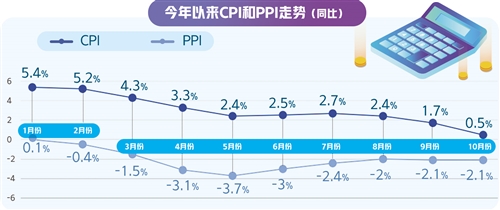
Affected by the high comparison base in the same period last year, the reduction of the hikes and the decline in pork prices, the CPI in October rose by 0.5% year-on-year, which is the first time that it has returned to "1" after 42 months since March 2017. At the same time, the kinetic energy of food structure pushing up CPI has been substantially alleviated. In October, the year-on-year growth rate of core CPI was the same as that of the previous two months, and the chain has remained in a positive growth range for three consecutive months, indicating that the current price center is running stably.
On November 10th, the National Bureau of Statistics released the data of national consumer price index (CPI) and industrial producer ex-factory price index (PPI) in October 2020. In October, CPI rose by 0.5% year-on-year, and returned to "1" for the first time after 42 months since March 2017; PPI decreased by 2.1% year-on-year, which was flat from the previous month.
The year-on-year increase of CPI dropped to 0.5%.
In October, CPI rose by 0.5% year-on-year, and the growth rate dropped by 1.2 percentage points from the previous month and 0.3% from the previous month.
Dong Lijuan, senior statistician of the Urban Department of the National Bureau of Statistics, said that the year-on-year increase of CPI dropped more, mainly due to the high base of comparison in the same period last year, the reduction of the hikes (that is, the price changes last year naturally transferred to this year) and the impact of pork prices from rising to falling. Among them, the price of food rose by 2.2%, which was 5.7 percentage points lower than that of last month, affecting the increase of CPI by about 0.49 percentage points. In food, the price of pork fell for the first time after rising for 19 months, falling by 2.8%. Non-food prices are flat. According to estimates, in the year-on-year increase of 0.5% in October, the impact of price changes last year was about 0.4 percentage points, down 0.8 percentage points from last month, and the impact of new price increases was about 0.1 percentage points.
Guo Liyan, director of the Market and Price Research Institute of China Macroeconomic Research Institute, also believes that the year-on-year increase of CPI in October narrowed significantly compared with last month, mainly due to the hikes.
"To measure the stability of the CPI hub, we generally look at the CPI excluding food and energy prices, that is, the core CPI. The core CPI can better reflect the macroeconomic operation situation, especially the dynamic balance between total supply and total demand. " Guo Liyan said.
The data shows that the core CPI excluding food and energy prices rose by 0.5% year-on-year in October, the same as last month. Guo Liyan said that the year-on-year growth rate of core CPI in October was the same as that in the previous two months, and the chain has remained in a positive growth range for three consecutive months, indicating that the current price center is operating stably. The prices of some goods and services that constitute the core CPI continued to rise slightly, such as housing, life services, education, cultural tourism and medical services, which all showed a slight positive growth month-on-month, among which the prices of air tickets and tourism rose more obviously month-on-month, reflecting the positive effect of the Mid-Autumn Festival on boosting consumption.
Guo Liyan believes that the kinetic energy of food structure pushing up CPI has been substantially alleviated. With the accelerated recovery of pig stocks and pork market supply, the current retail price of pork has been lower than that of the same period of last year, and the increase of pork price in CPI in October has turned from positive to negative year-on-year. In addition, seasonal fresh vegetables are on the market in large quantities, and the peak supply guarantee measures for National Day and Mid-Autumn Festival are in place. The price of pork and fresh vegetables have both declined, and food prices have become the main factor to lower the CPI growth rate.
Guo Liyan believes that energy prices are also a factor that narrows the year-on-year increase in CPI. International crude oil prices fell in the middle and late October, and the prices of gasoline and diesel in CPI dropped significantly year-on-year.
Industrial production prices are generally stable.
With the continuous recovery of domestic industrial production, the industrial production price was generally stable in October.
From a year-on-year perspective, PPI decreased by 2.1%, the same as last month. Among them, the price of means of production decreased by 2.7%, and the decline narrowed by 0.1 percentage point; The price of means of subsistence decreased by 0.5%, with a decrease of 0.4 percentage points. Among the major industries, coal mining and washing industries, as well as gas production and supply industries have narrowed the price decline. The price decline has expanded in the oil and gas mining industry and the oil, coal and other fuel processing industries. In addition, the price of non-ferrous metal smelting and rolling processing industry rose by 2.9%, the same as last month; The price of ferrous metal smelting and rolling processing industry turned from flat to rising, rising by 0.3%. The price of agricultural and sideline food processing industry rose by 1.9%, and the growth rate dropped by 2.0 percentage points.
According to estimates, in the year-on-year decline of 2.1% in October, the impact of price changes last year was about -0.1 percentage points, and the impact of new price increases was about -2.0 percentage points.
From the ring comparison, the PPI rose slightly from last month to be flat. Among them, the price of production materials rose by 0.1%, and the increase rate dropped by 0.1 percentage points; The price of means of subsistence decreased by 0.1%, the same as last month. From the survey of 40 industrial categories, there are 12 price increases, 3 fewer than last month; 18 decreased, a decrease of 1; Flat 10, an increase of 4.
Dong Lijuan pointed out that due to the temperature drop in the north, the demand for heating has gradually increased, and the prices of coal mining and washing industries, gas production and supply industries have increased by 2.1% and 0.4% respectively; The prices of chemical raw materials and chemical products manufacturing rose by 1.1%, the prices of chemical fiber manufacturing rose by 1.0%, and the prices of textile, paper and paper products industries and non-metallic mineral products industries all rose by 0.3%. Affected by the downward fluctuation of international crude oil prices, the prices of oil and natural gas mining industry decreased by 4.9%, and the prices of oil, coal and other fuel processing industries decreased by 1.6%. In addition, the prices of nonferrous metal smelting and rolling processing industry, ferrous metal smelting and rolling processing industry decreased by 0.3% and 0.1% respectively.
"PPI continued to shrink year-on-year in October, but it was the same as expected. The PPI was flat in October, which was slightly inconsistent with the price of raw materials purchased by PMI and the trend of international commodity prices, mainly due to the lower energy prices. " Zhou Maohua, an analyst in the financial market department of China Everbright Bank, believes that PPI will remain negative in the fourth quarter, but it is expected to continue the marginal improvement trend, mainly because domestic and overseas demand is still on the recovery track, especially the policy effect of supporting domestic demand continues to be released, exports show great resilience, and corporate confidence continues to increase.
Liu Xuezhi, a senior researcher at the Bank of Communications Financial Research Center, believes that although the rebound of PPI has weakened, it has not changed the overall trend. It is expected that with the recovery of the domestic economy, PPI is expected to return to positive growth next year.
The annual control target will be successfully achieved.
Guo Liyan said that the current overall price level is in line with the previous forecast of the trend of "before high and then low" and the expectations of most market institutions. In the first 10 months, the cumulative year-on-year growth rate of CPI was 3.0%. At present, the annual price control target of about 3.5% can be successfully achieved.
"Looking forward to the end of the year, the fourth quarter will be the low point of CPI for the whole year." Guo Liyan believes that with the acceleration and smoothness of the domestic economic cycle, especially the steady recovery of consumer goods and services consumption, the core CPI, which supports CPI, will continue to maintain a stable operation.
Zhou Maohua believes that although domestic demand is still weak relative to supply, the total retail sales of consumer goods in September increased positively for two consecutive months year-on-year, indicating that domestic demand is slowly recovering. From the trend, due to the gradual recovery of demand, seasonal factors will drive the price of meat and fruits and vegetables to rebound to a certain extent, but considering the good domestic supply conditions, prices will not fluctuate greatly.
Liu Xuezhi said that the year-on-year increase in CPI in October was significantly lower, in line with previous judgments, mainly due to the decline in pork prices, which led to a decline in food price increases. Non-food prices have remained basically stable, and the core CPI has remained at the level of 0.5% in recent months. Inflation is generally moderate, so there is no need to worry about deflation.
From the macro policy point of view, Liu Xuezhi believes that monetary policy will not be affected by the fluctuation of price level, and should remain flexible and accurate, and strive to serve the real economy.
Zhou Maohua believes that from the perspective of price performance, it is still necessary to increase support for the demand side. Under the background of normalization of epidemic prevention and control, monetary policy should continue to bail out enterprises, help small and medium-sized enterprises and manufacturing departments reduce financing costs, keep market players and stabilize employment. At the same time, the proactive fiscal policy should fill the shortcomings of infrastructure, guide industrial transformation and upgrading, improve policy efficiency, release the potential of domestic demand, and promote a more balanced and sustainable domestic supply and demand.